Making Bridging net-positive i.e We pay users to bridge.
Bridges generated more than $100+ Billion in on-chain volume and $240+ Million in fees in 2025.
And at Telis we are making it 10x faster than LayerZero, 90% cheaper than median bridging fee, and with 5x more route coverage (6320 possible routes).
CLS settles $2 trillion daily by moving just $20 billion in actual cash—a 99% netting efficiency. We're bringing the same level of efficiency to bridging.
Cross-chain space is growing at an exceptional 25%+ CAGR with $15+ Billion in monthly volume and $15-20 Million in fees generated. It is a market growing with DeFi's 40%+ CAGR. But the current leaders force tradeoffs between scale, cost and speed.
Telis will capture this share by eliminating these tradeoffs and enable sub-second settlement (MegaETH's millisecond block latency), sub 2 BPS cost (WCM Atlas engine), 80+ chain coverage by hedging on WCM.
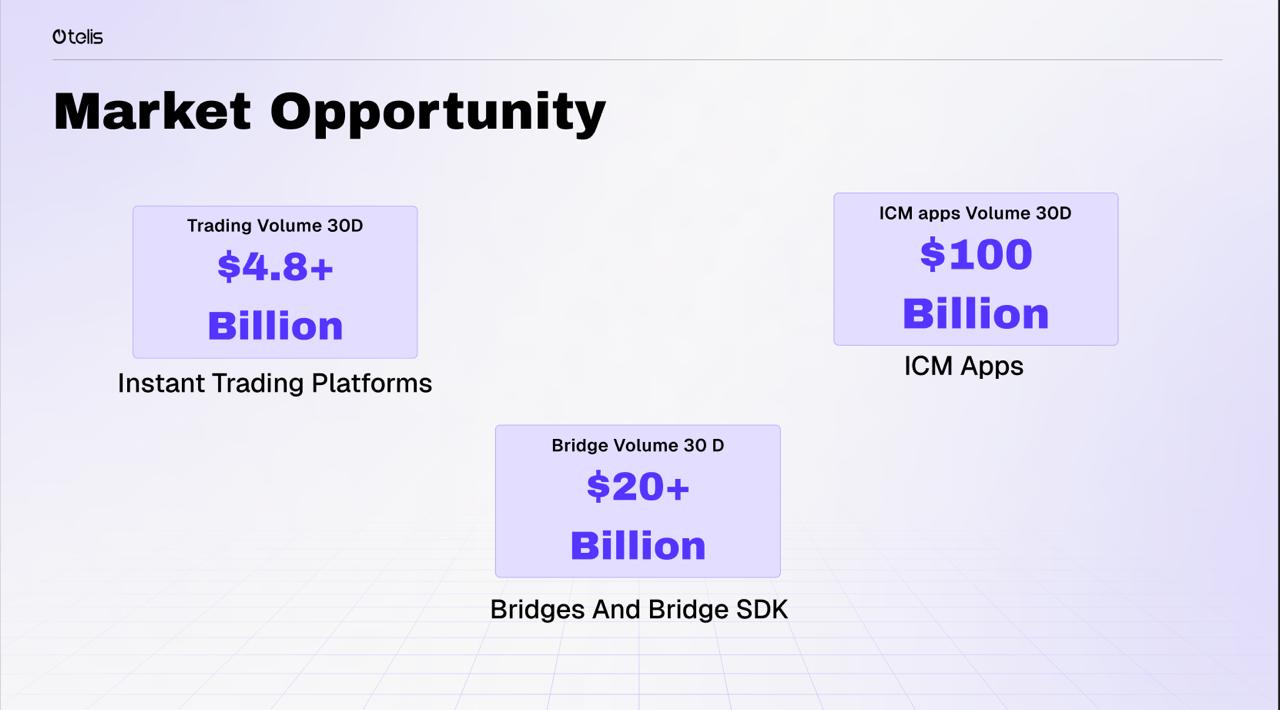
This also opens an underserved segment: ICM apps (prediction markets, perp DEXs, launchpads) that need atomic cross-chain deposits and collectively move $100B+ monthly but can't integrate existing bridges to enable atomic cross-chain transactions.
| Parameter | Relay | LayerZero (Stargate) |
CCTP (USDC only) |
deBridge | Telis |
|---|---|---|---|---|---|
| Route Coverage (>85%)* | 55% | 36.7% | 100% | 84% | 100% |
| Speed (<5 sec) | ✓ | ✗ | ✗ | ✗ | ✓ |
| Small Trade Cost (<50bps)** | ✓ | ✗ | ✓ | ✗ | ✓ |
| Large Trade Cost (<2 BPS)*** | ✗ | ✓ | ✓ | ✓ | ✓ |
| Chain Integration | 79 | 93 | 20 | 27 | 80+ |
*Ratio of Chains integrated and unidirectional routes between the chains
**<$500 trade size
***<$10,000 trade size
TL;DR: We manage treasuries across chains and DEXs to enable cross-chain transactions efficiently. Instead of "transfer of asset across chains", we focus on transfer of value and net out all possible trades—the most efficient money moving method traditionally.
Telis consolidates settlements across chains using WCM's Atlas risk engine to hedge all directional exposure and stay delta-neutral. Because our system works like an account book, we're extremely capital efficient and generate yield through funding rates, orderbook-onchain arbitrage, stablecoin yield, etc.
This keeps bridging costs low for users (<5 BPS) while LP principal stays protected. And when a user's trade brings net value to our balance sheet—e.g. bridging out of a chain we need to rebalance—we pay them to bridge. Their flow closes our hedge and saves rebalancing costs and we share that upside back to them.
🔗 For the exact trade flow see - info.telis.trade/Technical-Architecture
📚 Docs - info.telis.trade
We believe end users should be able to load any preferred asset from any chain on an app to be able to use it!
Launched Feb 25 as the primary bridge for MegaETH's public stress test — Base + Solana → MegaETH with $50 cap per tx. Airdropped Soul-Bound NFTs to create a retention loop.
48% of users independently called out speed as the standout feature. Zero lost funds. Zero failed settlements. 17.4% repeat usage with power users averaging 8.7 txns each.
Co-founded Sidebot (4k users, $40M+ volume). Ran $250k ARR Web3 marketing studio. Drives product architecture, GTM, and UX at Telis.
Co-founded Sidebot. Worked at Nethermind, Polygon. Built $50M+ liquidity pipeline at Zoth. Owns strategy and partnerships.